Identifying a well-built
Instrument
The
instrument each player selects will reflect their budget, tastes, prejudices,
the kind of music the play, and the sound they want to create. Fortunately builders are fairly diverse and
most work hard to satisfy a wide range of tastes. This page strives to outline the prominent
challenges of the harp builder’s trade, to identify areas where a lazy or
shoddy builder may be tempted to cut corners.
When
I evaluate my own work or other builder’s instruments, I examine the
harp’s sound, aesthetics, construction and finish. I evaluate the instruments ergonomics and try
to figure out what the builder has done to ensure the harps longevity.
Sound:
Is
the volume and general tone even across the instrument’s range? Building a nice sounding mid-range is easy compared
to balancing the bass and treble ends.
Pluck a nice fat bass chord then play a few notes at the top range. Does one drown the other out? How is the sustain after a note is
plucked? Play a fast tune then a slow
air. Does the mid-range get muddy? Do those left hand chords last too long, or
do they die out too fast?
Try
playing a familiar tune loudly then soft.
Play it an octave higher than you normally do. Then an octave lower. Any surprises? Sounds you like? Things you don’t like?
Some
of what you are hearing can be affected by the room you are playing in. A harp is going to sound different in your
practice room than it will in church or a noisy pub session. Try to select an instrument that fits your
practicing and performing environments.
Does
the harp respond predictably when you pluck lightly and then progressively
harder? Younger or weaker hands may
delight in an instrument that produces nice loud notes with moderate plucking
pressure, while an aspiring or veteran pedal harpist may want something that
provides more resistance to a forceful technique.
Aesthetics
Does
the harp have a pleasing shape? At one
time, the harp was an object of delicacy and grace. More and more harp builders are attaching two
planks of thick hardwood to each other, and bolting the resulting armature to
skinny coffin-box. Does the result look
like a finely crafted instrument?


Austere vs. Elegant - there
is a reason economy harps and inexpensive kits look pretty much the same. With four simple-to-make parts, it is the cheapest, and fastest way to build a harp. Complex shapes, carving, inlays &
bindings, or a smooth transition from knee block to the sound box require more planning,
precision, skill, and effort. Challenge
convenient acoustic theories that builders offer to justify designs they can
build with minimal effort or planning.
For
hundreds of years, skilled artisans have taken the time and effort to learn how
to sculpt wood into the sinuous curves and planes that have defined the
harp’s magical appeal. With modern
materials and tools, all of these refinements are easier than ever to
execute. Find a harp that embodies the
builder’s best efforts to enchant the ears AND the eyes. You should demand both.
Construction & Finish
Sight along the edges of the neck and Pillar. Do they sweep in smooth, graceful curves, or
do they meander, with odd high spots and hollows? Study the glue seams where parts are joined
to each other. Are they nice and
tight? Look at the lines of bridge pins
and tuning pins (on both sides of the neck).
Do they fall in a pleasing curve?
Are there splinters missing around the holes where a frenzied drill
press operator rammed the bits through the neck?
Are
the sound holes neat and symmetrical?
Usually the neck, pillar and sound box are made from the same species of
hardwood. Did the builder select premium
stock, match the grain and layout parts so they showcase the beauty of the
wood? Are there a lot of dings and dents
from careless assembly work?
Shiny,
high gloss paint jobs can easily double the labor of finishing. The harp has to be sanded to a finer
grit. The grain has to be filled and
buffed, 6-12 coats of finish must be evenly applied, followed by many hours of
careful polishing. Anyone that has ever
tried to maintain a polished marble counter top or the flawless finish on a new
car can also testify that the mirror finish will also show every ding, scratch
and smudge on it. Many harpers prefer a
semi-gloss finish, or a finish that shows a hint of the underlying wood
grain.
Either finish will require several
hours of careful sanding and/or scraping.
Look at the finish from multiple vantage points, under a good strong
light, at a low angle. Does the finish have a nice even luster and sheen? Are there obvious drips, brush marks or
holidays? Light, hazy areas or spots
where the builder didn’t clean up the glue? Are there coarse grit sanding scratches
under the finish? Dust motes or rough
spots that should have been fixed?
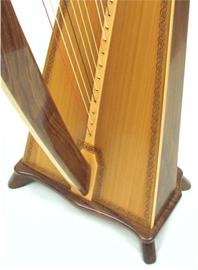
 I’ve always admired Larry Fisher’s stunning finish
work. His gloss finishes rival any
showroom Steinway. Photos, courtesy of
Fisher Harps
I’ve always admired Larry Fisher’s stunning finish
work. His gloss finishes rival any
showroom Steinway. Photos, courtesy of
Fisher Harps
Ask
the builder how hard it is to repair the finish if it is chipped or
scratched. Will the oil from your skin
gum up the finish on the edge of the sound board and sound box where the arms
rest while playing?
Are
the strings terminated neatly inside the sound box and onto the tuning
pins? Are the levers accurately
regulated? A good builder will not skimp
on hardware or the time it takes to
install it neatly. He should be able
to tell you who supplies his hardware, why he choose
it, and whether it will look this good five or ten years from now.
Ergonomics
As
you play the harp, does it have an even feel, or are there areas where the
strings change abruptly form stiff to floppy?
Are there strings that trip you up? check the
spacing. When you lean the harp back,
does it lean to one side or the other?
To the back feet have a wide, stable stance that will keep the harp from
tipping when you are playing aggressively?
It
is hard to make a harp that provides enough access for the hand in the top
octave. Is there enough space? A narrow sound box or offset string rib will
reduce the angle the harp player has to bend their right wrist to reach those
strings.
Few
harpers will complain their harp is too light, and builders are getting a lot
more disciplined and putting their instruments on a weight reduction plan. Is the harp unreasonably heavy for its size
and tension? Are there places the
builder could have eliminated weight without compromising the harp’s
sound or structural integrity?
Longevity
Take
a critical look at the harp head on. Is
the neck leaning away from the strings, is it perpendicular, or has it begun to
capsize towards the strings? Is the
joint between the neck and the pillar stable or are their joints beginning to
open up? A good stiff pillar, a sound
neck-to-pillar joint and securely fastened knee block will insure the neck
stays vertical and will minimize the need for regulation and bridge pin
adjustments down the road.
 How is the soundboard
fastened to the sound box? Did the
builder rely solely on glue, or does he use mechanical fasteners too? The builder should be able to tell you what
fastening system he is using and his track record with it – beyond the
warranty period too.
How is the soundboard
fastened to the sound box? Did the
builder rely solely on glue, or does he use mechanical fasteners too? The builder should be able to tell you what
fastening system he is using and his track record with it – beyond the
warranty period too.
If
the builder is vague or reluctant to discuss the number of blown boards he has
had to replace using this fastening system, it should tell you something. Some builders build harps with a lot of
belly, and that is not a bad sign. Look
inside the sound box, and inspect the liners at the bass end. Are they cracking away from the sides of the
sound box or the sound board?
Take
a look at the joint between the neck and the sound box. Are there big gaps at the front or back? What has the builder done to reinforce the
neck and keep it from cracking along the grain through the pins and screw holes
at the treble end? What remedies will be
available to the customer if the neck breaks?
If the harp is dropped or bumped hard, the feet can
break. Are the feet firmly attached and
robust? How hard is it to remove or
replace them?
These
may seem like a lot of nitty gritty details. There are a lot of questions to ask and things
to ponder when it you purchase an instrument you will be spending hundreds of
hours with over the coming years. I hope
these criteria will help you carefully evaluate the tradeoffs builder face when
they make a harp, and will help you get better value for the pile of money you
trade for a fine instrument.